

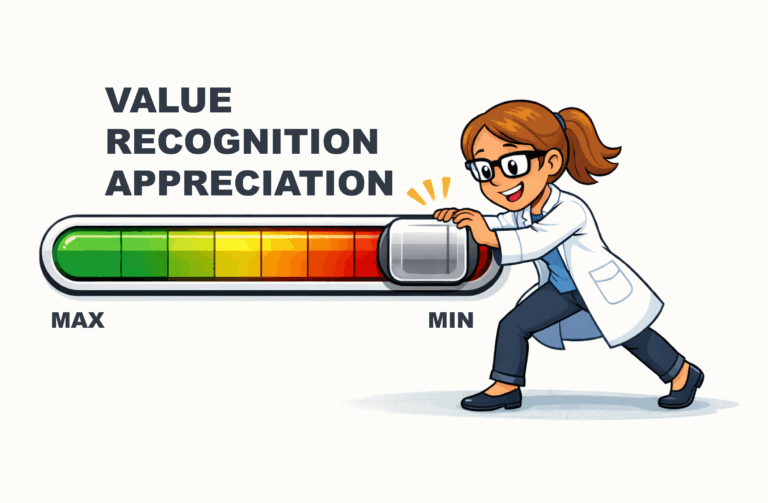
Everyone wants to be valued for their work.
When I worked as a scientific consultant, this was especially true. My colleagues and I were doing rigorous, thoughtful analyses—often under tight timelines—and we cared deeply about the quality of our research.
Over the years, I noticed something important: For clients to truly value our work, two things had to be true:
- We had to solve a problem that mattered to them.
- We had to show the solution to that problem in a way that was useful to them.
If either of those factors was missing, it didn’t matter how elegant our work was—ultimately it wouldn’t matter.
No one cares about what they don’t care about.
During a recent training, I walked a group of researchers through one of my core tools: a simple three-question worksheet designed to clarify the real-world problem their work solves.
They, like most researchers I’ve done this exercise with, were surprised at how difficult it is.
Often, their statement of the “problem” is technically correct but framed as an academic problem, not a real-world one. The difference between the two is subtle but important. It’s what makes people want to engage meaningfully with researchers and their findings versus tuning out.
For example:
Academic framing: Few studies have examined the relationship between diagnostic turnaround time and clinical decision-making.
Real-world framing: Patients may wait days or weeks for diagnostic test results. It’s unclear how these delays affect downstream clinical decisions and whether faster turnaround could meaningfully change patient outcomes.
The academic version isn’t wrong, but it’s abstract. It leaves the audience wondering, “So what?” The real-world version places the problem in a concrete situation involving patients, clinicians, and decisions with easily identifiable consequences.
That specificity does two powerful things. First, it makes the problem tangible and interesting to an audience. Second, it sharpens the researcher’s own focus, helping center the conversation on what truly matters.
When someone presents the academic version, I usually ask a simple follow-up question: “Why is that a problem?” or “Why does that problem matter?” The answer to either question almost always reveals the real problem that is most important to a stakeholder.
Understanding the problem you’re solving is the most important ingredient for being valued for your work.
Why? Because people don’t care about solutions to random problems; they care about solutions to their problems.
When researchers clearly convey what problem they are solving, they don’t have to fight for attention. They earn it.
Is your solution actually useful to help make decisions?
Once the problem is clear, the next challenge is explaining the solution in a way that your audience can use.
Useful research is more than just results. It’s about presenting those results so stakeholders can see how your findings affect a decision, action, or way of thinking.
Recently, I saw a researcher announce the publication of a study showing that people using a certain class of drugs have an elevated risk of an adverse medical event. This sounded like a solid study, but how high was “elevated?” And what was the baseline risk to understand whether that increase was meaningful?
Without that context, the finding wasn’t actionable. It didn’t help anyone understand whether or how it should influence their treatment decisions.
After a brief online conversation, I learned the answers to both questions. Only then could I fully understand—and appreciate—the real-world risk associated with the treatments studied.
Being valued for your research starts before you ever start writing.
Researchers often try to make their communications user-friendly by polishing formatting, tightening language, or adding visuals after they have developed their content.
While these efforts are wise, being valued for your work starts much earlier:
- Are you clear on the real-world problem you’re solving?
- Can you explain why that problem matters to your audience?
- Can you articulate the solution in a way that’s actionable for them?
When those pieces are in place, clarity follows naturally. And so does recognition.