

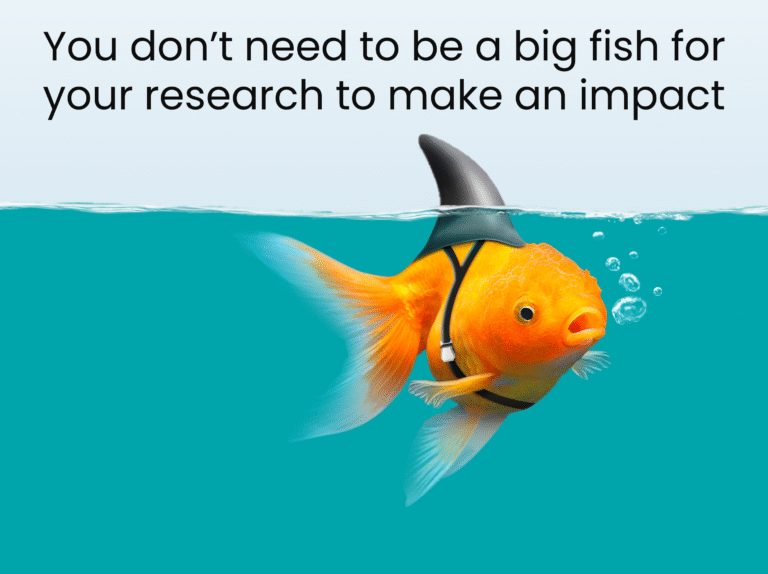
Ever feel like every presenter at a conference has a bigger reputation, a larger following, or more impressive slides? You’re not alone.
It’s easy to think, “I’m not a big name; no one is going to pay attention to my work.” That feeling is understandable. The well-connected researchers seem to have the spotlight, and the seasoned veterans have the confidence (and audience) that comes with experience.
But what if you didn’t need to be a “big fish” to for your research to be noticed? Turns out there is one surefire way to get your message heard, even without a built-in fan base: Ensure your presentation is focused and simple. That’s it.
The big names don’t have a monopoly on good presentation skills. In fact, some of them are terrible communicators. They just benefit from reputations that make people more willing to put in the effort to follow along.
If you don’t have that advantage yet, your job is to make your science so clear and engaging that no effort is required to understand it.
And research backs this up.
In their book Made to Stick: Why Some Ideas Survive and Others Die, Chip and Dan Heath write about a study they conducted in which they asked graduate students at a top university to deliver one-minute persuasive speeches to each other.
Everyone rated the talks highly, but when they were later asked what ideas they remembered from each speech, they were lucky to recall one or two from each presentation, and many couldn’t even recall any.
What made the difference between ideas that stuck and those that vanished?
They told a story. Among the students, 63% remembered the stories they heard while only 5% remembered any individual statistic. This makes sense; we are wired to understand stories. They are more engaging, easier to understand, and—most importantly—far more memorable than a list of facts. (That’s why we have to write down grocery lists!)
They had one clear point rather than multiple arguments. I call this your key message—the single takeaway you want the audience to remember even if they forget everything else. And it’s the one thing that presenters often never think about. But without a key message, most presentations collapse into a list of facts and data. And lists don’t stick.
Here’s what didn’t make a difference for memorability: charisma.
Speaking ability had nothing to do with whether any of the speakers were memorable. In fact, the Heaths concluded that a community-college student for whom English is a second language could outperform an unprepared graduate student—simply by being clear and focused.
So no, you don’t need to be a “big name,” and you don’t need to be charismatic. You just need to communicate your science well enough for people to get it, and simply enough for them to remember it.
Why do you want to make your research “sticky,” or memorable?
The Heaths describe a sticky idea as one that’s understood and remembered, and that has an impact—changing what people think or do. And if you look closely at why scientists present their work, that’s exactly what they want their research to do.
Common motivation 1: “I want to be respected as a valuable contributor to my field”
The scientists who earn recognition aren’t always the ones doing the most innovative research. They’re the ones who communicate the problems they solve and their solutions clearly, and frame them in a way that makes their audience care.
Common motivation 2: “I want to attract new opportunities”
The best way to do this is to make your expertise accessible. When I worked at a scientific research consultancy, we always tried to hire the best people we could find. We knew strong researchers with good communication skills created their own opportunities. Clients ultimately sought them out, and they easily drew in new projects and collaborations, growing the company’s bottom line.
Common motivation 3: “I want my research findings to be implemented”
You know you’ve conducted a solid study. Now your job is to convince others of its value and help them see why your recommendations should be acted on. Whether you’re seeking internal funding, applying for a grant, or influencing policy, you need your message to stick if you want to drive real-world change.
When presenting, be sure to do these 5 things to make your research stick in the minds of those who matter:
- Capture their attention. If no one is listening, no one is persuaded. (Also see “Polite indifference is the worst feedback you can get.”)
- Be understandable. If your audience doesn’t understand your work, they can’t value it—or you. (Also see “The secret to attracting opportunities is not just being a good scientist, it’s ensuring others understand your good science.”)
- Be credible. Convey both the complexity and nuance of your research in a way that is understandable and useful. (Also see “Whether you know it or not, we’re all selling something.”)
- Make them care. Everyone—even scientists—wants to know “What’s in it for me?” Frame your study around a problem that your audience cares about so they’ll care about your findings.
- Explain the meaning of your work. Your results are the “what.” The “so what” is even more important. It shows you’re not just reporting data, you’re interpreting it. The more you highlight the meaning behind your results, the more valuable your work becomes for your audience.
When you incorporate these elements (attention, understanding, credibility, relevance, and meaning) in your presentations, the result is research that not only informs but also influences.
Note that clear and influential scientific communication isn’t an innate talent; it’s a technique that anyone can learn.
If you’ve got a presentation coming up and want to make sure your message sticks, book a Presentation Power Hour. In one focused session, you’ll turn your complex research into a clear, compelling story that earns attention (no shark fins required).