

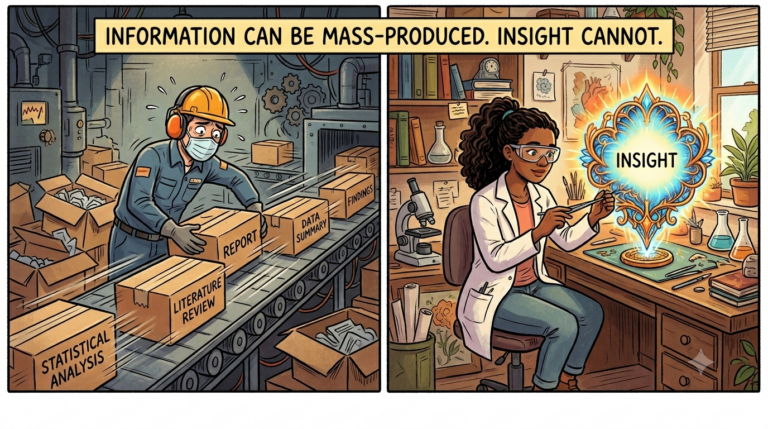
There was a time when knowing how to conduct a scientific analysis alone was enough to establish a researcher as an authority. Today, executing analyses is cheaper, faster, and easier for non-experts.
Fifteen years ago, the analysis du jour was the network meta-analysis. Teams that could perform one had a competitive advantage.
Over time, more researchers learned the methodology, and now software programs can generate all the standard outputs automatically. What once required specialized expertise became widely accessible to all.
As a result, the cost of producing these analyses plummeted, and the barrier to generating them disappeared. PubMed indexed just 13 papers with network meta-analysis in the title in 2010. In 2025, it indexed 2,473.
When the cost of producing information falls, so does the value of producing information. Because if anyone can generate the output, the output itself is no longer the differentiator.
And when more people can generate outputs, data becomes abundant—but insights do not.
The in-demand resource has shifted from generating information to generating understanding because stakeholders rarely make decisions from data alone. They’re made through judgment, context, and interpretation.
Decision-makers value researchers who can help them understand what the data means, why it matters, and what they should do next.
Your simply possessing information does not earn stakeholders’ trust in your judgment; rather, that trust comes from how you use that information to help solve problems.
Can you explain a complicated issue?
Can you make uncertainty understandable?
Can you help people see the implications?
Can you guide a decision?
Those abilities distinguish a trusted advisor from a technical contributor. They’re also what stakeholders value and organizations reward.
Make insights communication your competitive advantage.
Scientists often treat research communication as something that happens after a study is completed. But it’s more than that. It’s where the value of your study is created.
If no one understands the insights you discovered or how those insights solve an important problem, then your results become another data point in an overwhelming sea of information.
To be sure, technical excellence is essential. It is what gets you in the door.
But researchers who combine rigorous science with clear, strategic communication become the people organizations rely on to help them make better decisions.
Your job has never been just to produce scientific evidence. It’s to help stakeholders understand why your work matters, which in turn, makes them more likely to recognize the value of your expertise.