
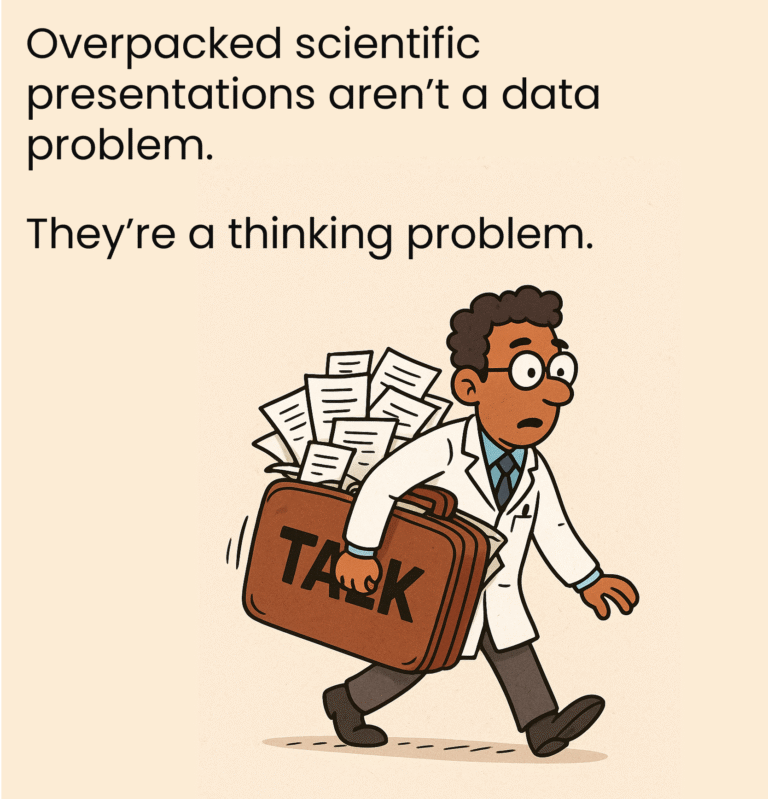
Why is cutting the unnecessary information from your own presentation so hard? Nobody wants to give a data dump. No one opens PowerPoint thinking, “Let me overwhelm my audience so thoroughly that they question my competence.”
We all know information overload is bad. When listeners are overloaded, they disengage. That disengagement might look like the classic glazed stare. Or it might be something more subtle but also more damaging: a snap judgment based on their own prior knowledge rather than full consideration of your findings.
It’s the same thing that happens at a restaurant when your server recites a dozen specials full of culinary jargon. Halfway through, you think, “You know what? I’ll just take the chicken.”
When you bury your research findings in overwhelming detail, your audience does the same thing. They default to the safe choice: what they already know.
Since no one wants to include too much content, why does it keep happening?
Why you may be the source of overload
To be fair, judging the right level of detail is incredibly hard when you’re the expert. You’ve lived with the data for months (or years), so nothing seems complicated to you. However, if you are on the outside looking in, it’s a different story.
But sometimes the problem is with you, and the instinctive habits you bring to communication. Here are four common reasons why you unintentionally overwhelm your audiences:
Reason 1: You want your work to look thorough.
You want others to see how rigorous your study is, so you walk them through every assumption, every step, every result.
What all that detail is saying is, “Look at the process I’ve undertaken, and look at how much information I’ve gathered through that process. Therefore, you should trust the findings.” What you’re not saying is “Look at the implication of the results and the problem being solved.”
In other words, you’re trying to persuade with the “how” and “what” instead of with the “why.” The problem is that no one cares about the “how” until they first buy into the “why.”
Until your audience buys into the meaning of your findings, the procedural details are a distraction.
Reason 2: You want to show that you are technically strong.
Years of training shape your instinct to demonstrate expertise by describing methodological nuances. In a job interview, that might indeed be a good strategy. But when you need to influence decisions with your research, such a strategy can hold you back.
Technical expertise is the ability to do the work. Scientific expertise is the ability to show why the work matters. Scientific experts understand the big picture and make it relevant for stakeholders by explaining the problem that has been solved and how that solution makes the world a little bit better.
Technical expertise is wonderful. It’s what enabled you to be a successful researcher. But your audience values scientific expertise far more.
Reason 3: You don’t think about what the audience needs to understand.
It’s tempting to think the journey you took to acquire the knowledge you have is the same journey your audience needs to take. You took the path, A → B → C → D → E → F → G, to get to your results, so you also give your audience the full tour. However, they don’t need that much background. They often just need A, B, and G to clearly understand the logic and relevance of your findings.
We do this intuitively in everyday life. If someone asks how you arrived at a restaurant, you might say, “I took the subway” not “First I left the house, walked to the train station, and went down the stairs. Then I tapped my card and waited on the platform.”
This is the same with scientific presentations. There are details that should be added to enhance credibility, but audiences are more trusting than you may think. If you present data that is understandable and logical without going into all the gory details, your audience will believe you.
Reason 4: You don’t take the time to edit.
As Benjamin Franklin said, “I have already made this paper too long, for which I must crave pardon, not having now time to make it shorter.”
Report writing and presentation prep take serious time. And when the clock is ticking, the instinct is to finish, not refine. Most researchers want to communicate clearly, but lack the time, structure, or know-how to edit effectively. And because communication isn’t the main part of their job, it rarely gets the attention required to make it exceptional.
I get it. I was a scientific consultant for many years, and time was a precious and constrained resource. If a task was completed, there wasn’t a lot of time to review it, so many of us had to check it off the list and move on to something else.
You don’t need a lot of details; you need the right details.
Achieving this balance is much harder than it sounds. When you’ve worked incredibly hard on a research study, every detail feels important. But clarity demands editing ruthlessly.
You’ll need to take a step back and think, “What is the crucial information needed for this audience to appreciate my findings?” Everything you present should serve your key message. Anything that doesn’t—even if it’s fascinating—belongs in the presentation recycle bin.
This is the part that most scientists struggle with.
Here’s where I come in.
Scientists study for years in their scientific discipline, so naturally they want to spend more time doing science, not talking about it. Spending precious time on their scientific communications does not always rise to the top of their to-do lists.
I help scientists close the gap between the quality of their work and the clarity of their communication—especially when time is limited and the stakes are high.
My job is to help you:
- Identify what truly matters for your audience
- Strip away what doesn’t matter
- Present your findings in a way that earns recognition, value, and opportunities
Because when you present with clarity, you don’t just share your research—you make people care about it.
And that’s exactly what I want for you.