

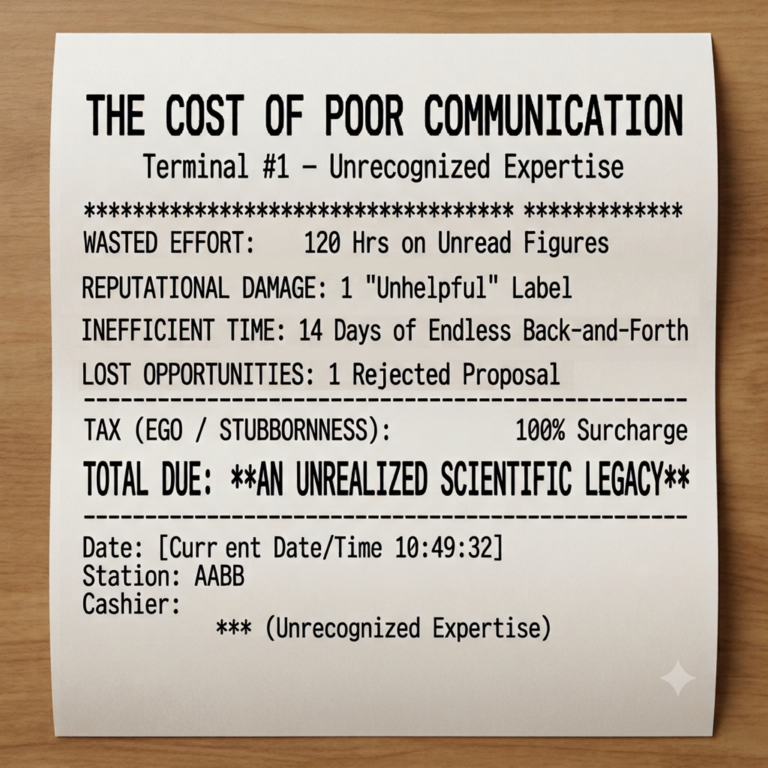
Before I started scientific communication coaching, I spent years helping my own project teams communicate their work more effectively.
The advice I gave them is much the same advice I give today:
- Make your section headers informative.
- Tell readers the most important point first.
- Remove information that doesn’t directly support your key message.
- Move supporting details to an appendix where interested readers can find them.
My own project reports and presentations consistently followed these principles. Interestingly, however, other researchers did not seem to widely adopt them.
Perhaps they felt putting serious thought into implementing these principles required too much effort. (It does. Clear communication requires careful thinking.)
Perhaps they felt the recommendations strayed too far from the traditional way scientific reports had always been written.
At the time, it didn’t seem like a particularly concerning issue. Reports were delivered. Presentations were given. Projects were closed.
The cost of mediocre scientific communication appeared to be zero. Today, I no longer believe that’s true.
Poor scientific communication is remarkably expensive. It’s just that the costs are rarely measured. Consider the following hidden costs:
Cost 1: Damage to your reputation
Whether we realize it or not, every report, presentation, and slide deck communicates two things simultaneously: the quality of the research and the competence of the researchers behind it.
When a report is difficult to follow, audiences rarely separate the research from the researchers.
They don’t simply think, “This presentation is confusing.” They often conclude, “This research must be flawed.” Or worse, “This team doesn’t seem very organized.”
Whether those conclusions are fair is beside the point. People naturally infer the quality of your thinking from the quality of your communication.
Cluttered slides. Disorganized reports. Important findings buried beneath technical detail. These don’t merely make information harder to understand. They undermine perceptions of competence, reliability, and expertise.
Clear communication isn’t simply an individual skill. It’s a vital part of an organization’s reputation.
Cost 2: Lost influence and future opportunities
Research exists to inform decisions. That is especially true in commercial scientific organizations.
Unfortunately, brilliant research does not automatically become influential research. Throughout my consulting career, I worked with researchers who produced exceptional science. Their reports were rigorous, complete, and meticulously documented.
The problem is that technically sound documentation often fails to answer the questions stakeholders care about most:
- What do these results mean?
- Why do they matter?
- What should we do next because of them?
When stakeholders must interpret the implications for themselves, many simply won’t. And if they don’t know how to use your findings to make decisions, then your research isn’t nearly as valuable as it could be.
That affects more than a single project. Research organizations don’t just sell analyses, they sell expertise.
Every client presentation, study readout, report, and conference talk shapes how others perceive your organization’s ability to solve important problems.
When communication consistently helps stakeholders make better decisions, organizations become trusted advisors. That reputation is what tips the scale toward future collaborations, contracts, and opportunities.
Cost 3: Wasted effort
Imagine spending months answering an important scientific question only to have your study report sit on a proverbial shelf because it wasn’t obvious how the findings related to the stakeholder’s strategic priorities.
The science may have been excellent. But if its communication fails, the value created by the research never reaches the people who need it.
Cost 4: Inefficient use of time
Commercial research projects operate under fixed budgets. As with any project, inefficient work eventually becomes expensive. Ironically, the project phase that often consumes most of the budget isn’t conducting the research, it is reporting it.
Why? Because scientists spend years learning how to execute rigorous research. They enjoy it and become remarkably efficient at it.
Communicating that research is a different story. Many researchers spend enormous amounts of time creating exhaustive tables, documenting every technical detail, and polishing information that stakeholders neither need nor use.
Those hours aren’t free.
They’re hours that could have been spent investigating the next important scientific question.
While creating focused, strategically relevant communications does require more thinking up front, it often requires less work overall. Because when you know exactly what your audience needs to understand, you focus on that and stop creating material they’ll never use.
So what can we do?
The encouraging news is that these costs are avoidable.
Scientific communication deserves the same deliberate practice as every other professional skill. That begins with three simple habits.
- Know your goal. Know what decision your communication is meant to inform, then prioritize the information that supports that objective.
- Seek feedback. Get an honest assessment of how well your communication works and what could make your key messages easier to notice and understand.
- Invest in communication as deliberately as you invest in technical expertise. Researchers spend years learning how to generate evidence. Very few receive formal training on how to communicate that evidence so others can immediately understand its importance.
Your goal probably isn’t just to produce excellent research. It’s to ensure that others recognize why your research is valuable to them.
Communication isn’t the final step of research. It’s the bridge between evidence and action.
Your friendly scientific communication coach,

Chief Simplicity Officer | science-clarity.com
If your team produces excellent science but you’re not sure stakeholders consistently recognize its value, let’s talk.
Helping research teams close that gap is exactly what I do.