

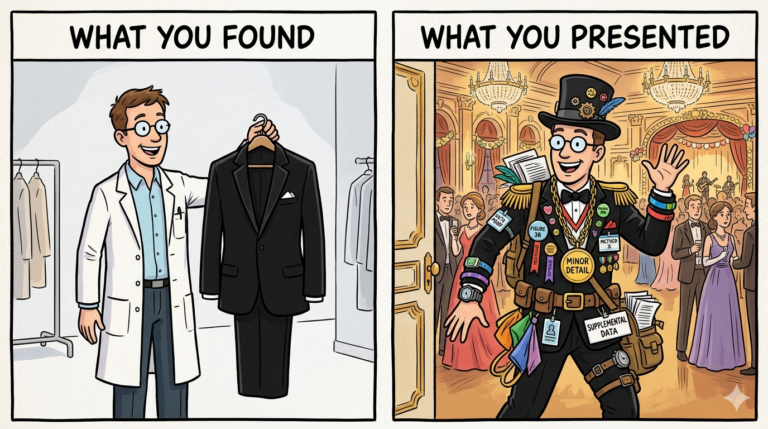
I’ve collaborated with other researchers to produce dozens of publications. One thing all these publications have in common is too much information tends to get included.
During the writing process, one author insists: “We need more detail explaining this methodology.” Another wants additional documentation, caveats, or subgroup results.
But even projects with few or no collaborators produce “Franken-papers” all the time. Why?
Because it’s easy to get lost in the details. Technical experts love focusing more on which methods and processes to include than on what the article is to say to readers. And though this information may be technically correct, it can also be unfocused and difficult to follow.
To avoid that scenario, you must first determine your key message—the single most important part of any research communication. Your key message answers the following questions: “Who am I talking to, and what do I want them to know?” Determining your key message helps you narrow down and fine-tune exactly which information should be included in your communications.
Without a clear message, you’ll lose track of what it is you are trying to communicate—and lose your audience along with it.
Deciding on a key message is your first step to discernment because every decision afterward becomes easier:
- What belongs?
- What distracts?
- What strengthens the story?
- What weakens the story?
Your message becomes a benchmark, a litmus test to know how to best answer these questions to make your story stronger.
Discernment also means that some very interesting information will need to go into the presentation recycle bin.
That’s hard for scientists.
Researchers spend enormous time and effort generating nuanced findings, careful analyses, and technically rigorous work. Naturally, they become attached to those details.
It’s a bit like asking someone who has lived in the same house for 20 years to downsize and part with cherished possessions.
Painful? Yes.
Necessary? Also yes.
Researchers see every detail of their work as relevant and meaningful. Audiences do not. To them, unnecessary information makes it harder to identify what’s important. And the harder it is for audiences to understand your message, the less likely they are to recognize the value of your expertise.
That’s where extreme discernment becomes necessary. Truly effective scientific communications require brutal honesty.
You have to continually ask yourself: “Is this information necessary to understand my key message?”
And if the answer starts with “Well, some people might find it interesting,” then probably no.
So how do you develop this kind of discernment?
Decide what you want your audience to remember from your communication. Experienced researchers know that a single study can produce multiple interesting conclusions. But not all conclusions deserve equal attention in every communication setting.
A conference presentation or poster works best when focused on a single takeaway. A journal manuscript may support several conclusions. But even then, one message still needs to be the star of the show, while the others play supporting roles.
Great scientific communication is not about including everything possible. It’s about helping your audience clearly understand what matters most—and that requires discernment.
Develop this skill and you will be able to turn technically excellent research into communication that is focused, clear, and genuinely useful to the people who need it.
Want help identifying your key message? Email me. I’ll show you how to do it.