

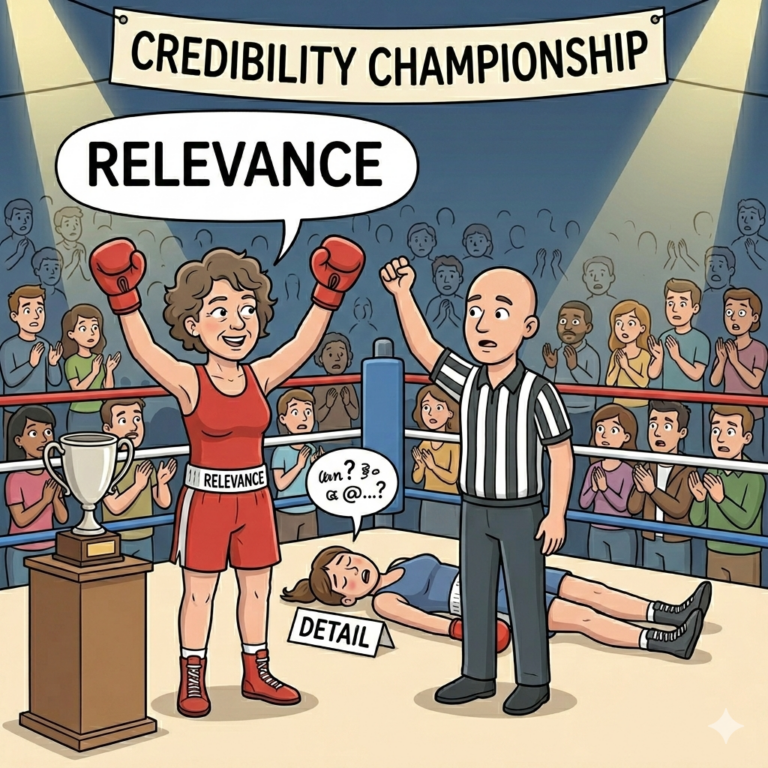
You spent months executing a study as close to methodological perfection as possible. When it’s time to report or present your findings, you want two things: for your audience to see your work as credible and to influence what happens next.
So you do what many researchers do. You document everything because, as the reasoning goes, if you show all the rigor and nuance of your study, people will see how strong the work is and trust your findings.
The problem is that logic rests on the false premise that more detail automatically creates more credibility. Up to a point, it does. Appropriate documentation matters, and most researchers already document their findings well.
But once you move past the level of methods and results your stakeholders actually need, the marginal persuasive value of additional detail drops quickly. At that point, it often has the opposite effect, diluting your message and undermining credibility.
Credibility isn’t built with volume.
To understand why, let’s take a step back and ask a more basic question: How does one persuade someone to do something?
Whether it’s a consumer, a voter, a funder, or a senior leader, persuasion works the same way. People are convinced when they can clearly see how an action aligns with their interests, priorities, and constraints.
Marketers, politicians, and behavioral scientists all know this. They understand that credibility isn’t just about being right; it’s about helping someone decide what to do next. Research scientists can also use these tactics to boost their own credibility.
If detail isn’t the basis of credibility, what is?
Relevance. Relevance is the degree to which your work connects directly to what your audience needs, cares about, or is responsible for deciding. When your work feels relevant to your audience, people naturally engage. When it doesn’t feel relevant, your presentation is endured only because it’s on the agenda.
That’s why two people can hear the same information and have opposite reactions. The difference in their reactions isn’t about intelligence. It’s about alignment. And without alignment, researchers spend too much time explaining and defending their work, causing frustration and delayed decisions.
How do you make your work relevant?
Know your audience. A truckload of details may be exactly what an academic audience wants to hear, yet that would be the worst possible choice for a senior-leadership briefing. All audiences are different, and your job is to decide what and how much information is appropriate and deliver your findings accordingly.
Make the real-world significance explicit. Scientists tend to talk about data and methods as if their importance is self-evident. It usually isn’t. The methods you employed and the data you generated are valuable only when you clearly connect them to a real-world problem your audience already cares about. In this way, you gain their trust and signal that listening will be worth their time.
Explain the interpretation, not just the result. Many presentations stop at what was found. Credible communications go one step further by answering the following questions:
- What does this mean?
- Why does it matter now?
- What decision does it support?
If you don’t explain how to interpret your findings, your audience must guess. When this happens, there is no guarantee they’ll arrive at the right interpretation—let alone arrive at the same one.
When you leave meaning implicit, you leave alignment to chance. That rarely works in your favor.
The bottom line
For your research to be credible and persuasive, you just need to shift how you think about the goal of communicating it. You don’t need your audience to admire your study’s scientific rigor. You need them to understand why your research matters to them.
Credibility isn’t built by overwhelming people with information; it’s built by making your research unmistakably relevant.
This is the lens I use when helping researchers and teams make their work easier to understand—and easier to use.