

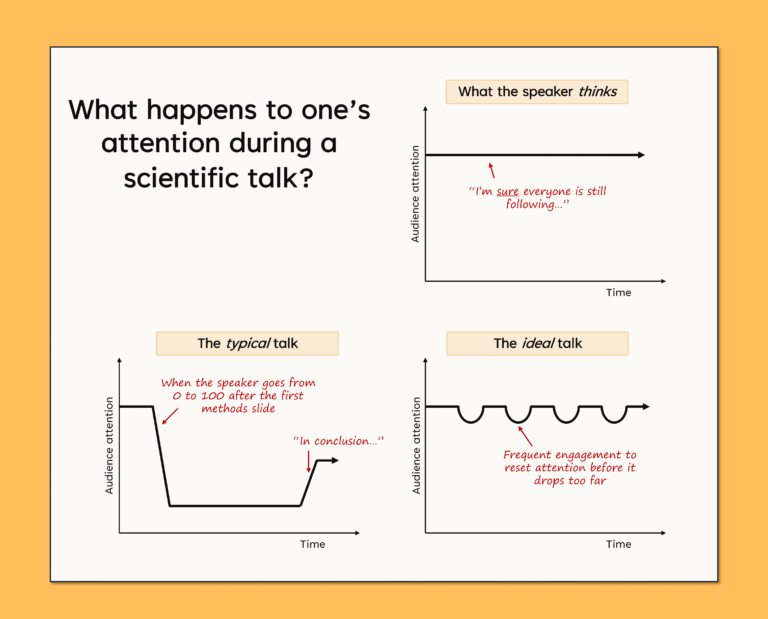
A few years ago, I was one of four panelists presenting at a conference. I spoke first and gave a brief introduction. It went fine. The second speaker bombed—hard. Since I had organized the conference, I paid close attention to the audience to gauge their reaction to the program. During the second speaker’s presentation, all I could see were downturned heads—people looking at their phones, notes, or just checked out entirely.
What happened next was interesting. As soon as the talk ended and the third speaker stood up, it was as if someone hit the reset button. Almost in unison, the audience straightened in their chairs, lifted their heads, and looked forward again.
That’s when I realized that disengaged audiences will come back—but only if they have a good reason to.
Why is it our job to keep people’s attention?
Shouldn’t they be responsible for listening?
Realistically, no. No one is entitled to anyone else’s attention. (OK, maybe small children are.) Even people with impressive titles may deserve your respect, but not necessarily your attention. (Also read “Polite indifference is the worst feedback you can get.”)
Attention is one of the most limited resources we have. It requires effort, brainpower, and energy, and is increasingly difficult to maintain. Even students who want to pay attention report that their focus fluctuates in shorter cycles as a lecture proceeds. One study found that attention spans dropped from 2.5 minutes in 2004 to just 47 seconds in 2020.
Biology is also part of the problem. The average speaker talks at about 100 to 150 words per minute. But we can listen at 275 words per minute and think at 1,000 to 3,000 words per minute. That’s a huge gap. And when there’s a gap, our brains look for something to fill it. If your talk isn’t keeping them focused, they’ll fill that gap with something else: scrolling on their phones, lunch plans, wondering whether they forgot to reply to that last email.
My top three presentation turnoffs (and I’m probably not alone)
- Slides packed with text. If I’m reading, I’m not listening to what you’re saying. (Also read “Use these brain rules to your advantage when presenting your science, or ignore them at your peril.”) And if the text isn’t self-explanatory, I’ll get lost. Once I’m lost, I’m thinking about my to-do list, not your talk.
- A monotone, disengaged voice. I’ve heard rumors that some scientists think they should not display enthusiasm when presenting because in doing so, they are not perceived as “objective.” But if you don’t sound enthused about your work, why should I be? Sound like you are telling me something interesting!
- Content that assumes I have a deeper understanding of the subject than I do. When presenters skip steps or assume a level of knowledge that I don’t have, it’s super frustrating and annoying, and that shuts me down.
Minds naturally wander; here’s how to keep your audience’s attention
Here are four ways to re-engage your audience in real time:
- Ask a question. Do not take a poll. A simple question will suffice. Asking the question that you are about to answer (e.g., “If people’s attention naturally wanes, what can you do to bring it back?”) or even a rhetorical question is an effective way to reinitiate engagement. Our brains are wired to want answers, so questions help snap listeners back into the moment.
- Tell a (brief) story. Break up your facts with a change of flow by presenting information via a short story or anecdote: “We planned our experiment to reward the mice with cheddar, but it turns out they didn’t like it. So we used Swiss instead.” Framing your information this way will recapture participants’ attention much more effectively than saying “Swiss cheese was used as a reward.” Stories make information easier to process, allowing the audience to engage for a longer time with less effort.
- Your talk should include periodic pauses so you don’t sound like a runaway train. Intentional silence can be powerful. The audience will think for a split second, “Hmm, what’s happening?” That generates curiosity, and curiosity garners attention.
- Give a quick summary. A simple “Here’s what we know so far . . . ” is an easy way to help anyone who’s zoned out catch up, get back on board, and reignite their attention. It also reinforces your main points.
Even small tweaks to your delivery can keep your audience’s attention on you and off their email. Because once you lose them, they will come back . . . just in time for the next speaker.